
Millets have had more policy support and more press than any Indian food category in a decade. Consumer awareness is genuinely high. Margins are better than in wheat or rice. And a great many millet products launched in the last three years are no longer on shelf.
The reason is not marketing. It is processing.
The rancidity problem
Millet grains carry a higher lipid content than rice or wheat, and those lipids sit in the germ, which is physically exposed the moment the grain is milled. Lipase begins hydrolysing them immediately.
The practical consequence: millet flour can develop noticeable rancidity within four to eight weeks unless the grain is properly conditioned before milling. Not badly stored flour, normally stored flour.
Brands discover this in a predictable sequence. Product launches, first month is fine, second month is fine, and somewhere in month three distributors start reporting a bitter or soapy off-note. By then there is stock across the market carrying the brand name.
The fix is heat treatment before milling, a controlled thermal step that deactivates lipase without cooking the grain. It is well understood, it is not expensive, and it is routinely skipped by plants milling millet as though it were wheat. If you are sourcing millet flour, ask whether the grain is conditioned before milling. The answer tells you whether your product will survive its own shelf life.
The texture problem
Millet proteins do not form gluten. Anything relying on gluten for structure (roti, bread, most cookies) behaves completely differently when you swap wheat for millet.
A hundred per cent millet roti tears rather than stretches. A hundred per cent millet cookie crumbles. Brands respond by blending back to wheat, which works technically and then creates a positioning problem: a product marketed on millets that is sixty per cent wheat invites exactly the scrutiny it cannot survive.
The honest routes are to formulate with hydrocolloids and binding systems designed for gluten free structure, or to choose formats where gluten was never doing the work in the first place: extruded snacks, porridges, beverages, ladoo. Extrusion in particular suits millets well, because expansion comes from starch gelatinisation and pressure drop rather than from protein structure.
The flavour problem
Cooked millet carries an earthy, slightly bitter note. Some consumers read it as wholesome. Many read it as unpleasant, particularly children, which is awkward, since children's nutrition is where much of the institutional millet demand sits.
Bitterness in millets comes largely from phenolic compounds concentrated in the bran layer, and it varies by species. Ragi is mild. Bajra is strongly earthy. Foxtail sits in between.
You can moderate it through degree of dehulling, through germination or fermentation steps that alter the phenolic profile, and through formulation that balances rather than masks. Masking with sugar is the common approach and it defeats the purpose, a millet product sold on health that carries fourteen grams of added sugar per serving will not survive a label-reading consumer.
Where the opportunity actually is
Set against those three problems, the categories that work are the ones where millet's properties are an advantage rather than an obstacle.
Extruded snacks and breakfast cereals. Extrusion cooks and sterilises in one pass, which handles the lipase problem structurally, the thermal load in the extruder does the conditioning for you. Texture comes from expansion, not gluten. This is the single most reliable millet format.
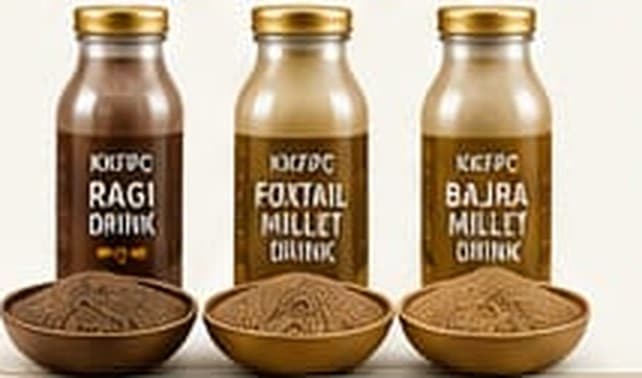
Beverages. Ragi and bajra drinks carry genuine calcium and iron stories. The technical work is suspension stability and flavour balance, both solvable. The shelf is still thin.
Instant mixes. Dosa, idli, upma, porridge. Traditional formats where millet is already culturally accepted, which removes the consumer-education cost that sinks more novel products.
Institutional nutrition. Anganwadi, mid-day meal and government nutrition programmes represent large, stable volumes with genuine nutritional intent behind them. Less glamorous than a retail brand, and considerably more reliable.
What to ask a millet manufacturer
- Do you condition or heat-treat the grain before milling? (If the answer is no, your flour will go rancid.)
- What shelf life have you validated, and by accelerated or real time study?
- What is your dehulling yield, and how do you handle the bran fraction?
- Can you show me a product you made twelve months ago?
That last question is the useful one. Anyone can produce a good millet product on day one. The question is what it tastes like in month nine, and a manufacturer who cannot show you one has not solved the problem. They have just not encountered it yet.
*Our millet system handles the grain end to end, including the conditioning step, and feeds directly into our extruders. It is where our food technologists spend most of their development time. Talk to us about a millet product.*
Want this applied to your product?
Describe what you are making and we will come back with an MOQ, a lead time and an honest view on whether the format you have in mind is the right one.