
Our formulation. Your brand. On shelf in weeks.
The fastest route from an idea to a product people can buy. Take a formulation that is already developed, tested and running on our line, put your brand on the pack, and skip the eight to sixteen weeks that development would otherwise cost you.
- 2-4 weeks
- Fastest route to shelf
- From 200 kg / 2,000 packs
- Typical MOQ
- 14 across 24 lines
- Categories available
- Not required
- Formulation development
Why most new brands should start here
Building a formulation from scratch is satisfying, expensive and, for most first products, unnecessary.
The honest arithmetic: developing a new shelf stable product costs eight to sixteen weeks and a meaningful chunk of your launch capital, and at the end of it you still do not know whether anyone wants to buy it. Starting from a formulation that is already running in production costs a fraction of both, and it lets you spend your capital where a new brand actually wins, on distribution and on reaching people.
If it sells, you will have the volume and the market evidence to justify developing something proprietary. That is a much better moment to spend development money than before you have a single customer.
White label and private label are not the same thing
White label means you take our formulation unchanged. Fastest, cheapest, and the same product may sit on the shelf under another name. That is a perfectly viable strategy (you are competing on brand, price and distribution), but you should know you are running it. Ask us about category or territory exclusivity; we will often grant it against a volume commitment.
Private label means we adapt the formulation to your brief. More heat, less sugar, a different pack, a nutritional target. The result is meaningfully yours, without the cost of building from nothing.
We will tell you which one you are buying, and we will put it in writing. Vagueness here is the most common source of dispute in the category, and it is entirely avoidable.
What you get
- A formulation that has already been through pilot, shelf life validation and commercial production
- Published MOQ, lead time and shelf life before you commit to anything
- Artwork checked against FSSAI labelling and claim rules before printing
- Batch-wise Certificate of Analysis with every consignment
- Documented process schedules, with recorded F0 values on thermally processed product
Where our own label helps you
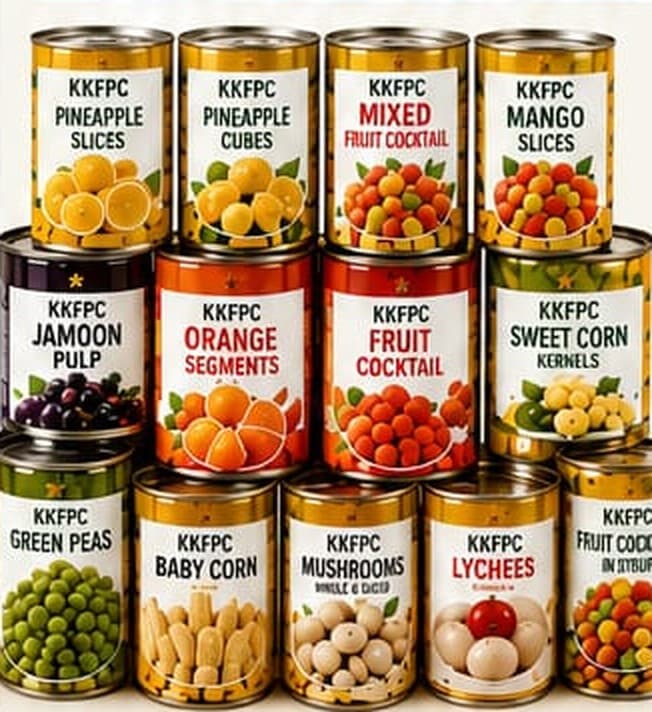
We run our own consumer brand, KKFPC, across canned fruit and vegetables, fruit pulps, juices, ready to eat meals, sauces and millet products. Those SKUs are not a side project. They are formulations we have taken to market ourselves, which means the shelf life data is real, the process is settled, and the product has survived contact with actual distribution.
Everything in that range is available under your brand.
How it works
- 1
Tell us the category and the volume
We come back with what we already make in that space, the MOQ, the lead time and an indicative per unit cost. Usually within a working day.
- 2
Taste it
We send samples of the existing formulation. You either approve it as it stands (that is white label) or tell us what to change, which moves it into private label.
- 3
Adapt, if you want to
Spice level, sweetness, pack format, a claim you want to support. One or two sample rounds, typically two to four weeks. Our team will tell you which changes are formulation work and which are simply a different pack.
- 4
Artwork and compliance
You supply the design. We check it against FSSAI labelling requirements and claim rules before it reaches a printer, because a non-compliant label discovered after the cylinders are cut means the whole run is scrap.
- 5
Production and despatch
We run the batch, test it, and ship with a Certificate of Analysis with every batch you can hand to a modern trade buyer or an export customer.
Questions
What is the difference between white label and private label?
White label means you take our existing formulation unchanged and put your brand on it, fastest and cheapest, but the same product may be sold by others under different names. Private label means we adapt the formulation to your brief, so the product is meaningfully yours. We state clearly which one you are buying and put it in the agreement.
Will the same product be sold to my competitors?
For standard white label, potentially yes. That is what makes it cheap and fast. We do grant category or territory exclusivity against a volume commitment, and it costs you nothing to ask. For private label where we have developed an adaptation specifically for you, exclusivity is usually part of the arrangement.
What is the minimum order for private label?
It depends on the category. Spices and dry blends from around 200 kg, instant mixes from 500 kg, extruded snacks from 2,000 packs, retort pouches from 2,000 pouches with a pilot first, beverages from 5,000 bottles, and canned products from 1,000 cases. Every product page on this site publishes its own MOQ.
Can I get samples before committing?
Yes, and you should. We send samples of the existing formulation before any commitment, and we run a paid pilot batch for products where the process meaningfully changes the product, retort in particular. Approving a formulation without tasting the retorted version is how brands end up surprised.
Who owns the formulation?
For white label and standard private label, we do. That is what you are paying less for. If you want to own the formulation outright, that is contract manufacturing, and we will assign it to you in writing. Decide this before development starts, not after.
Other ways we work
Contract manufacturing
You own the formulation and you intend to keep owning it. We provide the plant, the process engineering and the food technologists to scale it from a kitchen batch to a production line without losing what made it work.
Facility on rental
Rent our licensed facility by the batch or the shift, bring your raw material, and produce your own product under our supervision. It suits founders validating a product, brands who would rather not share a formulation at all, and seasonal producers who do not want equipment idle for ten months.
Product development
Formulation development, scale up, shelf life validation and regulatory review. This is the team that tells you why your product will not survive the process: before you have printed 20,000 laminates that say it will.