Building a food factory in India costs somewhere between two and twenty crore, takes twelve to eighteen months, and commits you to a fixed set of technologies before you know which of your products will sell. Private label removes all three problems at once. You use somebody else's plant, somebody else's licences and somebody else's food technologists, and you put your brand on the pack.
That is the pitch, and it is broadly true. What follows is the detail nobody puts on their homepage.
Private label, white label, contract manufacturing, the words matter
These three terms get used interchangeably, including by people who should know better. They describe genuinely different commercial arrangements, and which one you are buying changes who owns what.
White label means the manufacturer already has a formulation that is developed, tested and running in production. You put your brand on it. It is the fastest and cheapest route to market, and the trade-off is that the same formulation may sit on the shelf next to yours under a different name.
Private label usually means the same base product adapted for you (your spice level, your sweetness, your pack format), so the result is meaningfully yours even though the underlying formulation started as the manufacturer's.
Contract manufacturing means you bring the recipe. The manufacturer scales it, produces it and hands it back. You own the formulation outright; you are buying capacity and expertise, not a product.
Ask which one you are being sold. A manufacturer who is vague about this is being vague for a reason.
What it actually costs to start
Entry costs vary by category, and anyone quoting you a single number across all food is guessing.
| Category | Realistic first-order value | Notes |
|---|---|---|
| Spices & dry blends | ₹50,000 to ₹2 lakh | Lowest barrier; 200 kg gets you started |
| Extruded snacks | ₹1.5 to ₹4 lakh | Higher if you need custom seasoning developed |
| Retort ready to eat | ₹2 to ₹6 lakh | Pilot trial usually charged separately |
| Beverages (PET) | ₹2 to ₹5 lakh | Add ₹1 to 3 lakh if you want a custom bottle mould |
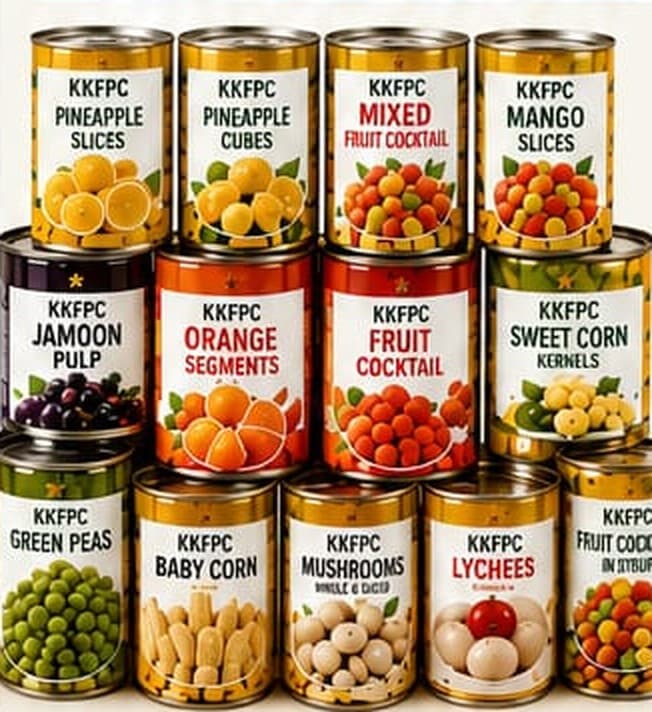
| Canned fruit & vegetables | ₹3 to ₹8 lakh | Tin minimums are high; 1,000 cases is typical |
On top of the product itself, budget for packaging design and printed laminate, often the largest single line item for a first run, because print cylinders and plate charges are one-time costs amortised over a small volume. Budget also for FSSAI registration, barcodes, lab testing and, if you are exporting, certification specific to the destination.
Minimum order quantities, honestly
MOQ is the number most manufacturers hide behind a contact form, which is exactly why it is worth publishing.
Typical ranges across the Indian market:
- Spices and dry blends: 200 kg upward
- Instant mixes and flours: 500 kg upward
- Extruded snacks: 2,000 packs upward for an existing seasoning
- Retort pouches: 2,000 pouches, with a pilot batch of around 100 kg first
- Beverages: 5,000 bottles for standard formulation
- Canned products: 1,000 cases, tins carry the highest minimums in food
A manufacturer offering to run 200 units of a retort meal is either subsidising you to win the account or does not understand their own changeover cost. Neither is a stable basis for a long relationship.
Timelines: what "four weeks" actually means
The honest answer is that lead time depends entirely on whether you need development work.
Using an existing formulation: two to four weeks from purchase order to despatch, assuming packaging is ready. Packaging is almost never ready, and it is the most common cause of delay.
Adapting an existing formulation: four to six weeks. One or two sample rounds, then production.
Developing from scratch, or scaling your own recipe: eight to sixteen weeks. Formulation, pilot batch, shelf life study, then production. Anyone promising a genuinely new shelf stable product in three weeks has skipped the shelf life study, and you will find out which one in month four.
Shelf life validation is the step brands try to skip and should not. Accelerated studies give an indication in four to six weeks. Real time studies take as long as the shelf life you intend to claim. If you are printing "12 months" on a pack, somebody should have evidence for it.
The compliance layer
Every food product manufactured in India needs to come out of an FSSAI-licensed facility, and the licence category has to cover your product type. That is the floor, not the ceiling.
Beyond it:
- Labelling must comply with the Food Safety and Standards (Labelling and Display) Regulations: nutritional panel, allergen declaration, veg/non-veg mark, FSSAI logo and licence number, date marking, and the manufacturer's name and address.
- Claims are regulated separately and strictly. "High in protein", "sugar free" and "immunity" each have specific conditions attached. Get this checked before the print run, not after.
- Export adds destination-specific requirements: FDA registration for the United States, EU-specific compliance for Europe, and often a third party audit standard such as FSSC 22000 or BRCGS that the buyer specifies.
Ten questions to ask before you commit
- Which is it: white label, private label, or contract manufacturing to my recipe?
- Who owns the formulation at the end, and is that in writing?
- What is your MOQ for my specific product, in units, not in vague terms?
- Can you run a pilot batch before I commit to production volume, and what does it cost?
- What is your shelf life validation process, and will you give me the data?
- Which processing lines do you own, and which do you arrange elsewhere?
- How do you handle allergen changeover between clients, and can I see the records?
- Will you give me a Certificate of Analysis with every batch?
- What happens if a batch fails specification, who bears the cost?
- Can I visit and see the line my product will run on?
Question six matters more than it looks. Most manufacturers use partner capacity for at least some technologies, which is completely normal and often sensible, freeze drying and vacuum frying are capital intensive enough that very few plants own them. What matters is whether they tell you. A manufacturer who is straightforward about what they own and what they arrange is telling you something useful about how they will behave when there is a problem.
Choosing a manufacturer
Certifications are the entry ticket, not the differentiator. FSSAI is mandatory; FSSC 22000 or BRCGS signals a plant that has been audited to a recognised standard.
What actually separates manufacturers:
- Do they have food technologists, or just operators? A plant that can only run what you hand them cannot help when the formulation does not survive the process, and it usually does not, first time.
- Can they pilot? A manufacturer who will only run full production batches is asking you to bet your capital on an untested product.
- Is the range deep enough to grow with you? Changing manufacturers for your second product is expensive and slow. A plant with a single line will eventually become a constraint.
- Do they publish anything concrete? Equipment lists, MOQs, lead times, honest availability. Vagueness at the research stage tends to predict vagueness later.
Where to start
Work out which of the three arrangements you actually want, get your category's realistic MOQ, and budget for packaging properly. It is the line item that surprises almost every first time brand.
Then talk to two or three manufacturers and ask all ten questions. The answers, and how comfortable they are giving them, will tell you more than any brochure.
*We manufacture under all three arrangements (white label from our own formulations, private label adapted to your brief, and contract manufacturing to your recipe) across 24 processing lines. If you want a straight answer on MOQ and lead time for your specific product, send us an enquiry and you will get one.*
Want this applied to your product?
Describe what you are making and we will come back with an MOQ, a lead time and an honest view on whether the format you have in mind is the right one.